

S&P 500 at highs, how long will it last?
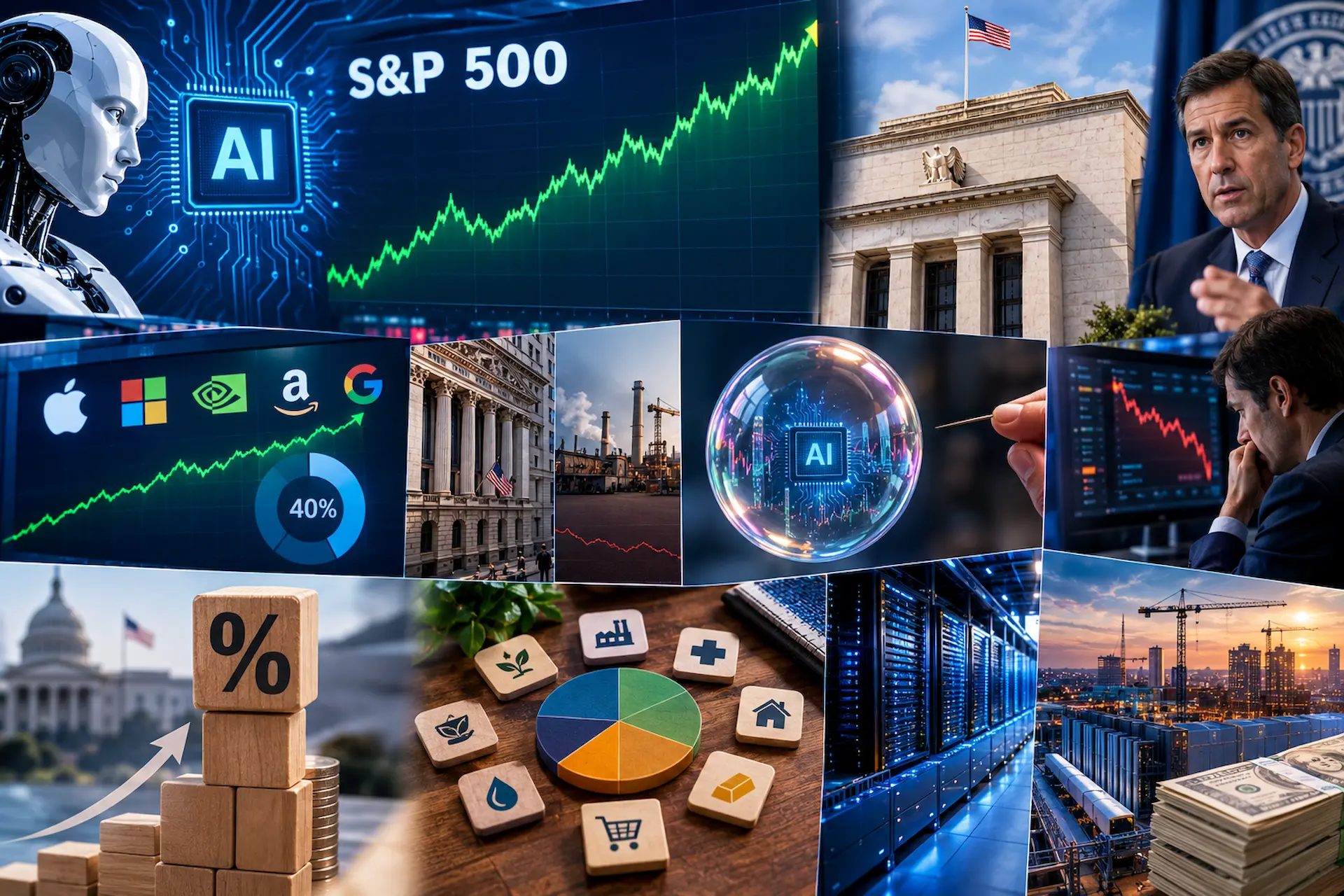
The boom in the prices of the technology sector driven by AI has led the main American and global stock market indicator, the S&P 500 index, to all-time highs. The debate on a possible bubble is on the table
The boom in the prices of the technology sector driven by Artificial Intelligence (AI) has led the main American and global stock market indicator, the S&P 500 index, to all-time highs. The debate about a possible bubble is constantly on the table.
Despite the Nasdaq notching its biggest weekly drop since last June, the S&P 500 managed to hit its all-time high last week and it is undeniable that it has been mainly AI and the technology sector, close to 40% weighting in the index, that have driven it to reach that record. Meanwhile, other sectors, such as finance and industry, have participated little.
Once again, the prices of companies in the «old economy» have lagged behind in terms of market recognition. At least, for now, since doubts about the sustainability of the debt that companies linked to the AI business are incurring periodically assail the sector (the withdrawal of several IPOs of large technology companies is a good example of this) and in recent days we see investors reducing exposure to companies most linked to artificial intelligence and looking for alternatives in traditional and defensive sectors
Warsh, Interest Rates and Stock Markets
Federal Reserve (Fed) Chairman Kevin Warsh knows that economic conditions are favorable and in line with forecasts. Considering the upward trend in price indices (despite being in practice energy self-sufficient, the US is no stranger to the rise in the cost of energy), Warsh could choose to prepare the markets for a rate hike in October.
However, I think it is very unlikely that it will do so and it will not be until next December that we will see interest rates rise in the US and even this is not certain. Low interest rates are favorable for the stock market and especially for large technology companies and their financing/investments. But let’s remember that this situation of accommodative rates is not going to last forever and, when they rise, liquidity conditions will worsen, which will cause a more than likely decline in the S&P which, according to analysts specialized in that market, would reach 5 – 15%.
In any case, the chart below shows us the historical evolution of the S&P 500 according to the Fed’s rate regime when it faces preventive hikes, if one arrives in December this would be the case, which will not be followed by more hikes (foreseeable scenario due to a drop in inflation in the coming quarters) within the next 12 months:
Conclusion: at this time, we should not be overly concerned about equity volatility even if the US rate hikes that are priced in today were to occur.
What to Expect Now
In this environment, on the one hand, investors are looking for opportunities to diversify their portfolios and not focus exclusively on assets linked to AI and technology in general, both of which are increasingly saturated (I insist that the increase in financing costs may aggravate the apparent, at times, fragility of the market) and, on the other, we must keep an eye on how hyperscalers continue to issue record volumes of debt as they anticipate. There is a somewhat confusing narrative that it will take much more investment in fixed assets (capex) to drive the boom in AI infrastructure and will continue into next year to reach $1.3 trillion or $1.4 trillion. Will the market be able to absorb it? We will see.
In any case, I don’t think the underlying fundamentals of the tech sector are getting worse. The excesses of a bubble are not yet perceived and hence, if the aforementioned decline in the US stock market occurs and depending on the liquidity conditions of the moment, we could be facing a favourable investment opportunity in the long term.
The normalization of capex spending by the large technology companies that build, own and operate digital infrastructure and data centers (the aforementioned hyperscalers such as Amazon, Microsoft, Meta, Google, etc.) and the expansion of their margins due to increases in productivity thanks to AI itself, will be the turning point in the monetization of AI and, in turn, the key factors for the future of the S&P 500 stock market.
PS for seasoned sailors in the stock market and electoral processes: before ours, we will attend the midterm elections in the US. If we take a look at the historical data for October and November, during a midterm election cycle, the aforementioned periods are usually the strongest months of the year.